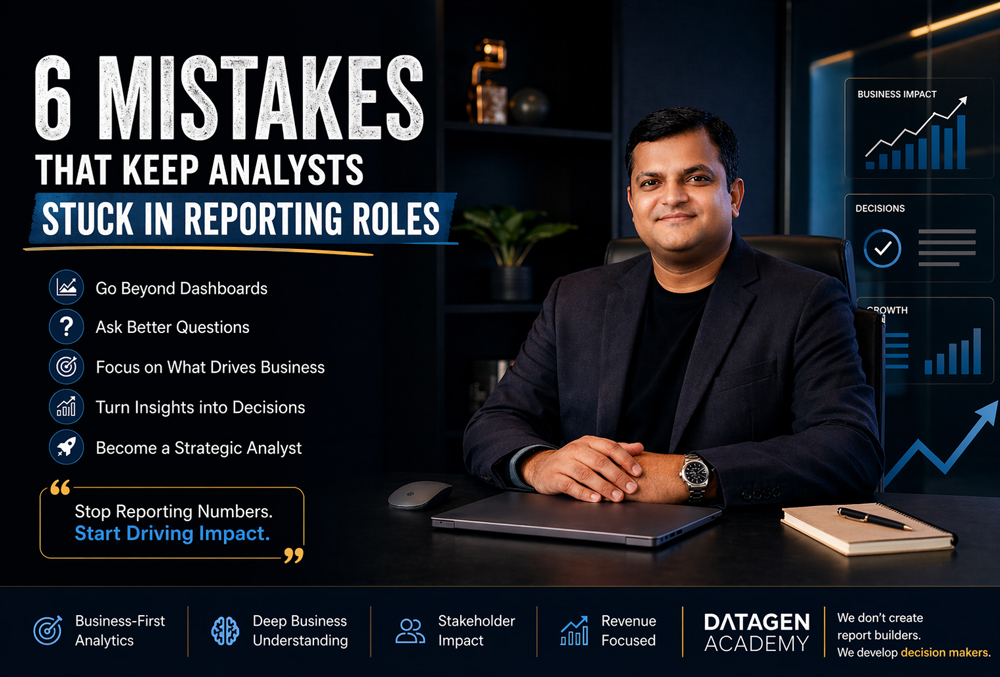
Analysts do not get stuck in their careers because they lack SQL, Excel, or BI skills; they get stuck because they operate as order-takers who describe numbers instead of business partners who drive decisions. Moving from a reporting role to an advisory role requires mastering business context, understanding trade-offs, and translating data into revenue impact. If your work stops at “here is what happened” instead of “here is what we must do next,” you are building dashboards, not decision systems.
The market is full of analysts who can build a clean dashboard. It is far thinner on analysts who can explain what the numbers mean for growth, margin, customer behavior, and executive action.
You can write flawless Python pipelines and design visually stunning BI interfaces, but if stakeholders glance at your report, say “thanks,” and make their decisions based on gut feeling, you are functioning as a reporting system, not an analyst. Businesses are investing heavily in analytics and decision systems, yet many still struggle to turn those investments into measurable commercial value.
The real career risk is simple: if your work only answers “what happened,” you stay close to output. If your work helps answer “why did it happen, and what should we do next,” you move closer to influence. Here are the six critical mistakes keeping capable data professionals trapped in reporting roles.
1. Confusing Reporting with Analysis
Reporting is useful, but it is not the final destination. The problem is stopping there.
A reporting mindset focuses on what is happening, while an analytical mindset investigates why it is happening and what decisions should follow. When a stakeholder asks for last month’s numbers, a reporting analyst will simply state that revenue is down 8% and conversion fell.
A business-first analyst asks a different set of questions:
- Which specific segment drove the decline?
- Did cheaper acquisition campaigns reduce our overall lead quality?
- Was the conversion drop a pricing issue, a traffic mix issue, or checkout friction?
The first person updates the business; the second helps the business respond.
2. Starting with the Dashboard Instead of the Decision
Many analysts begin with the stakeholder request: “Build me a dashboard.” Serious analysts begin with: “What decision is this supposed to support?”
Building a solution without a shared understanding of the problem leads to metric cemeteries-dashboards full of numbers with no operating consequence. Before building anything, you must ask:
- What decision will this report actually change?
- What action becomes possible if this metric moves?
- What threshold would trigger an intervention from leadership?
- What is the financial cost of being wrong or late?
Asking these questions improves the analysis and instantly repositions you from an order-taker to a decision partner.
3. Treating Metrics as Isolated Numbers (The CAC Trap)
A metric by itself is rarely the insight. It becomes useful only when tied to business context, trade-offs, and downstream outcomes.
Take acquisition metrics. CAC is not enough. Without proper customer acquisition cost context, you might report a dropping CAC as a massive marketing win. But CAC only tells you what it costs to acquire a customer; it hides profitability and payback speed.
Here is what acquisition metrics analysis looks like when viewed through a business-first lens:
| Metric | What it tells you | What it hides if used alone | What to pair it with |
| CAC | Cost to win a customer | Profitability, quality, payback speed | CLV, payback period, margin |
| Conversion rate | Efficiency of the funnel | Traffic quality, pricing impact | AOV, revenue per visitor, segment mix |
| ROAS | Ad return signal | Retention, refunds, contribution margin | CLV, repeat rate, gross margin |
| Lead volume | Top-of-funnel activity | Qualification quality, sales efficiency | Lead-to-close rate, sales velocity |
If you want to contribute to marketing efficiency analytics, you must stop reporting isolated costs and start tracking sustainable growth metrics.
4. Stopping at Aggregates and Missing the Leak
Averages are career traps. When analysts stay at blended totals, they often miss the real story where the business is bleeding.
A dashboard might show that overall performance is stable, completely hiding the fact that one channel is carrying the weight while another segment is actively destroying margin. If you only repeat summary reporting, you act like a passive monitor.
A serious analyst breaks the number apart to find the leak:
- By acquisition channel
- By user cohort
- By product category or pricing tier
- By specific stage of the conversion funnel
That is how hidden revenue leaks become visible to the executive team.
5. Sending Charts Without Recommendations
Many analysts believe neutrality means stopping at the chart. In reality, it usually means you are forcing the stakeholder to do the thinking you were hired to support.
In mature data cultures, analytics is expected to recommend actions. You should never deliver a report without a clear narrative. A strong delivery pattern includes:
- The What: What exactly changed?
- The Why: Why did it likely change?
- The Impact: What does this mean commercially?
- The Action: What action do you recommend the business takes?
- The Next Step: What specific metric should be monitored next?
That final layer is the difference between a “helpful data puller” and a “strategic analyst.”
6. Measuring Activity Instead of Business Effect
Analysts often inherit vanity-heavy reporting systems tracking traffic, impressions, opens, and raw lead counts. These numbers are not useless, but they are incomplete.
Good analytics does not start with “what can we track?” It starts with “what outcome are we trying to move?” A lower CAC can look excellent until retention weakens and the payback period stretches. A revenue spike looks healthy until you discover it came from aggressive discounting that damaged overall profitability. Always measure the economic effect, not just the marketing activity.
The Business Problem-Solving Lens: How a Real Analyst Thinks
When a stakeholder says, “CAC is down, performance looks better,” the weak analyst celebrates the metric improvement. The serious analyst investigates the business reality.
Instead of assuming a cheaper cost-per-click is a win, an elite analyst interrogates the data. They check if lead quality changed, if downstream conversion worsened, if the average order value dropped, and if the gross margin survived the “improvement.” They avoid surface-level conclusions by cutting the data by segment and cohort, looking for operational trade-offs rather than isolated wins.
Real-World Scenario: When “Better CAC” is Actually Worse Growth
Context: An e-commerce brand reports that paid social CAC fell 18% over six weeks. Leadership is pleased, and the acquisition dashboard is completely green.
Business Problem: New-customer growth is up, but profitability is under pressure and Finance is unconvinced.
Analytical Approach: A serious analyst does not stop at the headline CAC. They compare CAC by campaign alongside conversion rate, AOV by new customer cohort, and the contribution margin after discounts.
Key Signals Uncovered: The deeper read shows CAC improved only because the team widened targeting and heavily increased discount-led offers. Conversion rose, but AOV fell drastically. More importantly, repeat purchase behavior from these new cohorts is much weaker than prior cohorts.
The Insight: Customer acquisition cost improved, but the business became weaker. The channel became cheaper at the top of the funnel but economically destructive underneath.
Business Recommendation: Reduce discount dependency and immediately judge media efficiency on cohort quality and margin, not headline CAC alone. This shift protects the business from scaling unprofitable growth.
Why Datagen Academy Teaches This Differently
Most of the training market focuses on outputs: how to write the query, how to use the tool, how to build the chart. At Datagen Academy, we focus on decision framing.
We do not create tool operators. We develop analysts who can sit with marketing, sales, product, operations, or founders and ask the right questions. We teach you not just to calculate KPIs, but to interpret their business meaning, diagnose revenue leaks, and make grounded recommendations. This is the gap the market still under-teaches, and it is the exact gap that turns a junior report builder into a commercially trusted executive partner.
FAQ: Transitioning from Reporting to Business Analytics
Why do analysts get stuck in reporting roles?
Because they become known for producing updates, not for improving decisions. Reporting builds visibility, but real analysis builds influence.
What is the difference between reporting and analysis?
Reporting explains exactly what happened in a clear format. Analysis investigates why it happened, what it means for the bottom line, and what action the business should take.
Is learning more tools enough to grow as an analyst?
No. Tools are infrastructure. Official executive-level analyst roles emphasize stakeholder requirements, asking the right questions, and providing strategic recommendations over software proficiency.
Why is CAC alone misleading?
CAC only measures the cost of getting someone through the door, not their economic quality. Without CLV, margin, retention, and payback context, cheaper acquisition can still produce weak, unprofitable growth.
How do I move from dashboard work to real business analysis?
Start every request with the decision, not the chart. Define the stakeholder, the underlying business problem, the metric logic, and the recommended action before you build anything.
Conclusion
Most analysts do not plateau because they lack technical ability. They plateau because they were trained to report activity instead of interpret business reality.
The upgrade is not cosmetic; it is commercial. When you learn to connect metrics to decisions, and decisions to revenue, retention, efficiency, and risk, your work stops being a reporting function and starts becoming a core business function.
Want to stop building basic reports and start driving real business impact?
Let’s connect on LinkedIn. I regularly share executive-grade analytics frameworks, KPI teardowns, and strategies to help you become a business-first analyst.